
One of the quieter ironies of a successful career is that the further you climb, the more fragile the structure underneath becomes. The house gets larger. The school tuition becomes a line item you do not renegotiate. The vacations your family now expects show up every year whether or not the bonus does. Aging parents need help. Success is supposed to feel like security. When all of it runs through a single paycheck, it is the opposite.
Why higher income often means higher vulnerability
High earners face a specific kind of concentration risk. Lifestyle expenses scale with the paycheck, so the household becomes dependent on that one deposit continuing without interruption. A $60,000 earner might carry $3,500-$4,500 in monthly obligations and can often replace the role in a competitive but accessible market. A $250,000 earner often carries $15,000-$25,000 a month, faces a thinner replacement market, and has almost no room to cut fixed costs without upending the life they built.
What professionals making $200,000+ usually discover too late is the trap in the middle: they know they need a second income stream, but every hour they have goes to protecting the job that funds everything. That is how you end up with high income, no spare capacity, and complete dependence, the pattern we see across finance, tech, healthcare, and consulting.
The risk compounds. Replacing a $250,000 position takes six to twelve months on average. Age discrimination accelerates after forty-five even when nobody says the word. Industry disruption can erase entire role categories. One efficiency initiative can end a twenty-year run, and the lifestyle expenses do not pause while you search.
Why the usual diversification tools do not solve this
Real estate, stocks, and starting a business each have a place. None of them, on their own, produce the monthly cash flow high earners need if the career is interrupted, without becoming a second full-time job.
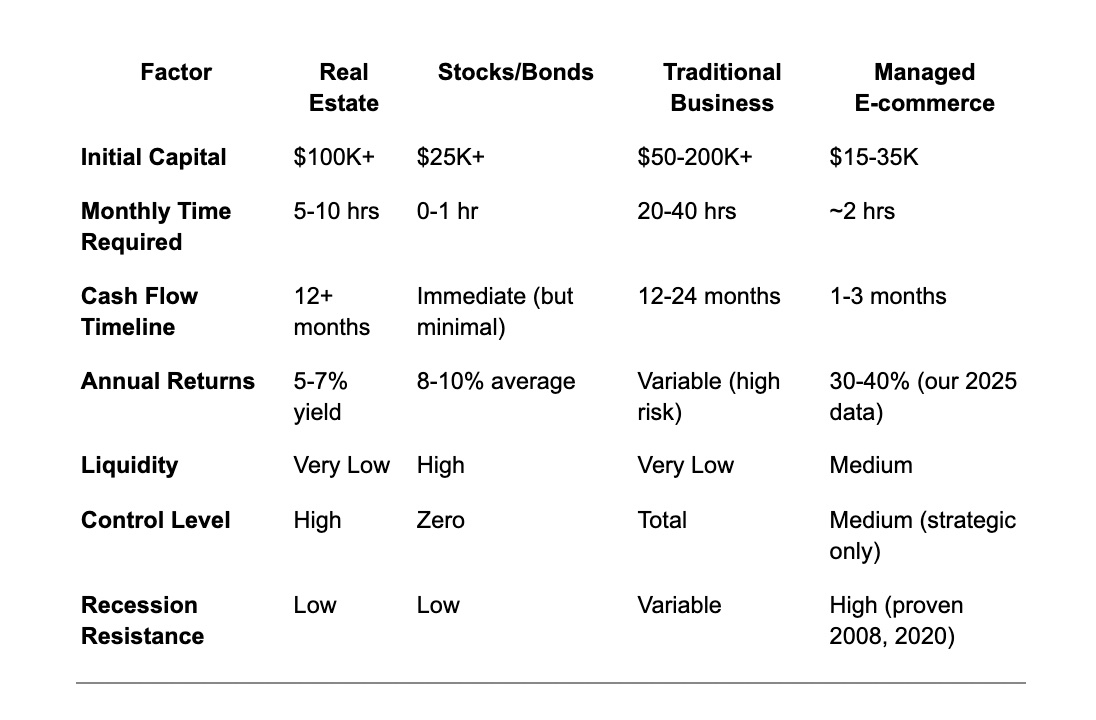
Real estate builds long-term wealth, but in 2026 the barriers are steep: $100,000+ down payments, rates in the 6-7% range crushing cash flow, rental yields of roughly 5-7% after taxes, insurance, and maintenance, five to ten hours a month of management, and poor liquidity when you need capital quickly. Plenty of professionals discover that rent barely covers the mortgage after expenses.
Stock market investing is a solid retirement foundation with historical averages around 8-10% when markets cooperate, dividend yields of 2-4%, and regular 20-30% drawdowns. You have no control, and paper gains do not pay this month's mortgage.
Starting a traditional business can create independence, but it asks for 20-40 hours a week early on, six to eighteen months to profitability, often $50,000-$200,000+ of capital, and a high failure rate. That is incompatible with most high-earner schedules.
These are incomplete tools for the immediate problem: generating monthly cash flow that protects you from career disruption without requiring a second career.
Why e-commerce shows up in crisis years
Online retail has held up across economic shocks because it serves product access, not discretionary luxury spending. In 2008, stocks fell about 37% while e-commerce still grew roughly 3.5%. In 2020, the Dow dropped about 37% in five weeks while e-commerce jumped about 44%. People still buy household essentials, still compare prices, and still prefer delivery when uncertainty rises.
From managing 300+ stores through varied conditions, the pattern we see is simple: e-commerce cash flow can remain usable even when stock portfolios drop 30%+ and rental properties hit payment trouble. That is not a guarantee for any one store. It is why the category belongs in a diversification conversation that is usually limited to tickers and doors.
How a managed store fits a busy professional
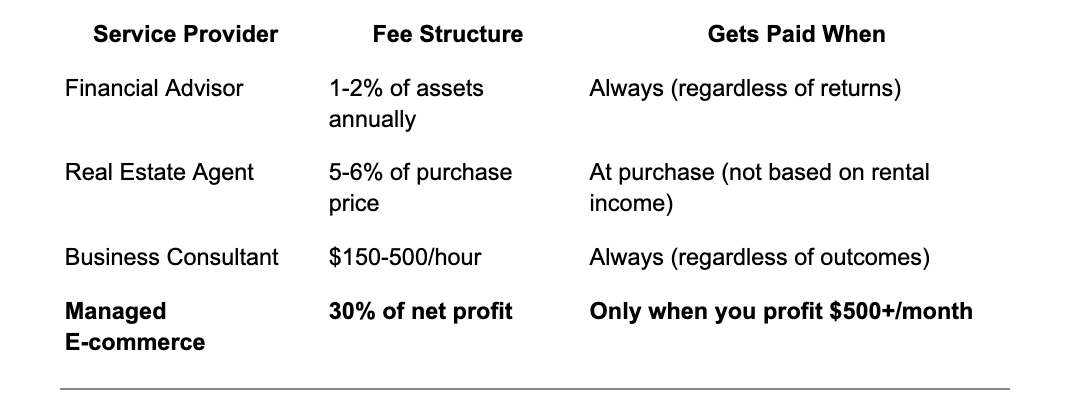
A managed e-commerce store is a turnkey operating partnership: professional operators handle daily operations, marketing, and fulfillment; you retain ownership and receive profit distributions. Ongoing involvement is typically about thirty minutes a week of strategic oversight, not packing boxes.
Product research uses performance data across 300+ stores. Store setup and compliance usually complete within about thirty-one days, with two to three hours of your time for verification and access. Daily operations, fulfillment, supplier communication, shipping, returns, customer messages, policy compliance, sit with the operator. Marketing and growth sit there too; many partners review reports and approve scaling decisions weekly.
The sell-first, buy-later model reduces inventory risk. Products are listed, a customer pays, then inventory is purchased against that order and shipped. Capital recycles on platform payout cycles rather than sitting in a warehouse of unsold stock.
Why 2026 makes the single-paycheck problem sharper
Three forces are converging. Goldman Sachs research has forecast that AI could eliminate or significantly alter on the order of 300 million jobs globally by 2030, and many $100,000-$200,000 roles involve analysis, research, content, and data work that AI already touches. Corporate restructuring is normalized; tech layoffs in 2023-2024 reset expectations, and average tenure at large tech firms is often measured in a few years, not decades. Traditional 60/30/10 portfolios still assume stable employment funding contributions, a growing economy supporting prices, and consumer spending driving profits. If the job goes, those assets rarely produce next month's cash flow without selling into whatever market you happen to get.
False diversification is stocks plus bonds plus real estate as multiple bets on the same economic outcome. True diversification is career income plus investment growth plus monthly cash flow that can survive different scenarios. The test is blunt: if you lost your job tomorrow, what income arrives next month?
What happens after a store matures
After roughly twelve to eighteen months, successful stores often reach a more predictable cash-flow rhythm. For a $25,000 initial investment, some partners see monthly revenue in the $8,000-$15,000 range with net profit of $2,000-$4,000, your share depending on the split in your agreement, often illustrated around 70% of net in educational examples ($1,400-$2,800/month). Results vary widely; these are not promises.
From there, partners typically choose one of three paths: take distributions for current cash flow; reinvest for growth; or sequence a second store once the first is stable. None of those paths require quitting the primary career.
What people are really asking
How much time does this take, what happens if it underperforms, and how it differs from building a store yourself. Setup is a few hours. Ongoing review is about half an hour a week. If you have not recovered your initial investment by month sixteen, we pause our profit share and continue managing until you have, per the service agreement, then return to the contracted split. Building it yourself means twenty to forty hours a week and a long learning curve. The managed model is ownership without operational burden, closer to rental property with a manager than to a side hustle you run at midnight.
We focus on eBay, on the order of 133 million active buyers and three decades of platform history, because search demand already exists. We are not asking you to fund traffic the way a Shopify store does. Capital for many operating partnerships starts around $20,000+ industry-wide; your exact terms are in your agreement after a strategy call. FTC performance detail, including average and range outcomes, is available on that call.
That is the high earner paradox stated without soft language: success can create fragility. A second deposit that is not tied to your employer is one of the few levers that changes the math. Ecom Accelerator builds and runs the store so you are not the bottleneck. Soft close only, if the model fits, the next step is a strategy call where we walk the FTC disclosure and whether your timeline matches the maturation curve.
Frequently Asked Questions
1. Why are high earners more financially vulnerable than lower earners?
+High earners face greater vulnerability because their lifestyle expenses scale proportionally with income, creating complete dependence on a single paycheck. Replacing a $250,000 position takes 6-12 months on average, while monthly obligations of $15,000-25,000 don't pause during job searches.
2. Can traditional investments solve the high earner income diversification problem?
+Traditional investments like real estate and stocks serve wealth-building purposes but fall short of providing monthly cash flow diversification. Real estate requires $100,000+ down payments and 5-10 hours monthly management. Stocks offer 2-4% dividend yields and don't provide reliable monthly income.
3. What makes e-commerce different from other income diversification strategies?
+E-commerce provides monthly cash distributions without requiring a second full-time job, large capital deployment, or significant time investment. Managed e-commerce stores can generate consistent income while you maintain your primary career.
Disclaimer: Performance figures referenced are based on our earnings claims disclosure and reflect historical results from January 2025 through December 2025. These figures are not a promise or guarantee of future performance. Results vary widely based on factors including product selection, platform policies, account health, customer demand, pricing, and operational execution. This is a business opportunity, not an investment, and there is risk of loss. Our FTC-backed earnings claims disclosure shows 32% ROI on inventory sold from January 2025 through December 2025.